What Changes When a Gathering Grows from 20 to 60 to 200
Compare how arrival, sound, staffing, food, visibility and contingency change as a gathering grows from 20 to 60 to 200 people.
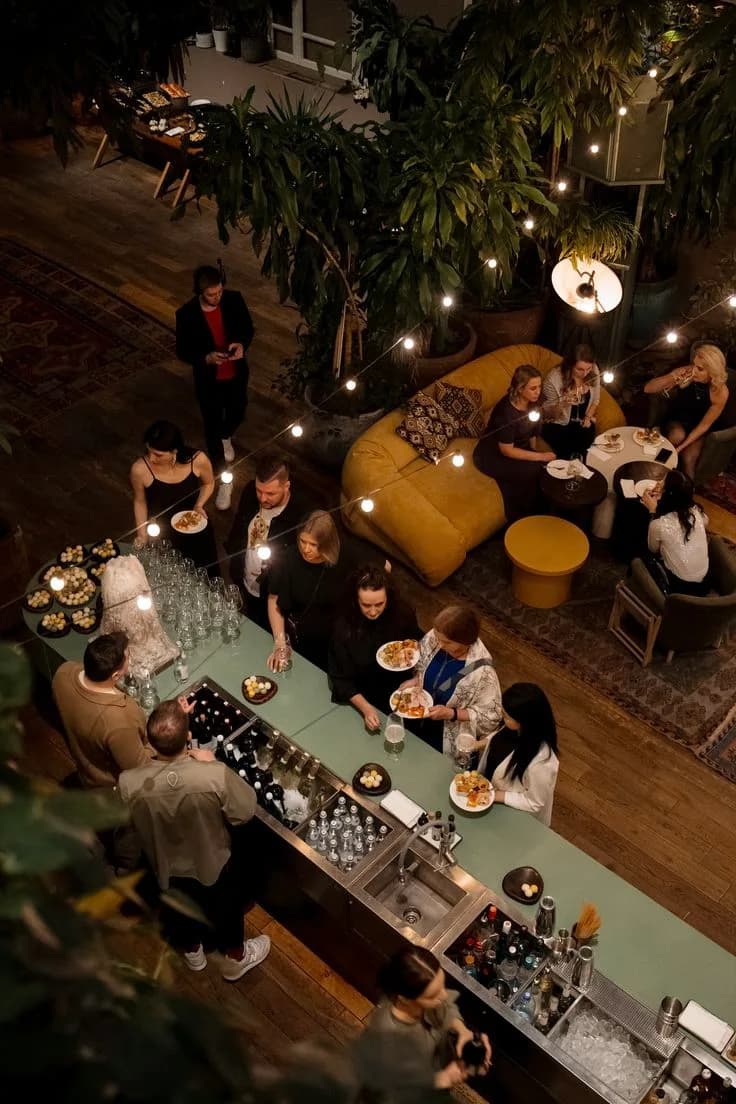
At 20 people, the host can notice an empty chair and ask whether someone is lost. At 60, arrivals form a system. At 200, that system needs owners, equipment and a backup. The organiser's job has changed faster than the headcount.
Listed capacity cannot describe that change. Around 20, one room may still behave like one conversation. Around 60, sightlines, registration and transitions need deliberate design. Around 200, staffing, service, access and contingency become part of the programme. These are planning archetypes, not legal thresholds.
Read the three scales as different briefs
The numbers 20, 60 and 200 are not universal breakpoints. Different formats use space differently. The host and applicable authorities determine permitted capacity for each venue and format.
Use the scales to expose new jobs. Ask whether the host can still manage arrivals personally, whether everyone can see and hear, whether food and washroom use can remain informal, and whether one person can notice and solve a guest problem while the programme continues.
When an answer changes from yes to no, add the operation that replaces it.
At 20, the gathering can still feel like one conversation
A 20-person event is small enough for the host to recognise faces, adjust the pace and explain changes without a formal announcement. That intimacy is useful. It can also hide planning gaps because the host expects goodwill to solve them.
Decide whether the group is one conversation, several small ones or a sequence of both. A long table can hold a shared meal or working session. A circle can support discussion. A styled room can carry atmosphere without additional production.
The room still needs an edge. Make space for bags, late arrivals, someone who needs a pause and any food or equipment that should not sit in the centre.
One person can usually greet guests, but give them a list, exact entrance and way to reach the organiser. A small group arriving at once can still block a residential lobby, staircase or cafe counter.
Informal service may work, though dietary information, water, waste and cleanup still need owners. A single table can serve food and then become the programme surface only if the reset is planned.
Do not add amplification or screens by habit. Test whether ordinary speech and the actual content are visible from the least favourable seat. Small gatherings often benefit from less equipment and better positioning.
At 60, transitions become designed systems
At 60 people, the room may still feel personal, but informal operations begin to strain. Several guests can arrive while the organiser is solving another problem. A food queue can cross the route to the main activity. Side conversations can mask a speaker.
Decide whether guests need names checked, badges, instructions or only a welcome. Place the arrival point where a short queue does not block the door. Give late arrivals a route that does not cross the focal area.
Mark the speaker, screen or demonstration. Stand where the last guest would be and test the view. A room may hold 60 standing while serving only 40 useful sightlines.
Sound becomes a distribution question. The solution may be a better speaker position, a quieter room or amplification. Ask a qualified supplier when equipment is needed.
Moving 60 people takes time. If the programme uses smaller groups, mark where they go, how instructions travel and how everyone knows when to return. Avoid putting a critical breakout behind the food queue or through the only washroom route.
Food, drinks and waste need a path that does not fight the programme. More service points can shorten queues while requiring more staff and replenishment access. Choose the model with the caterer and host.
At 200, operations become part of the guest experience
A 200-person gathering can still feel generous and specific, but only when operations are visible to the team before they become visible to guests.
Name owners for entrance, guest list, floor, stage or programme, vendors, technical systems and incident response. One person may hold more than one role only when the timing allows it.
Write the communication path. A volunteer should know whom to call when a guest cannot find the entrance, a supplier arrives at the wrong gate or a programme block runs late.
Guests, performers, caterers and equipment may need different routes or times. Confirm vehicle access, loading, stairs, lifts, holding areas and building rules with the venue. Do not infer them from the main entrance.
At this scale, people can be inside the venue and outside the experience. Check the view and sound from edges, columns, side zones and the back. If a screen or relay is needed, include it in power, setup and budget.
Service capacity affects programme timing. A short break is not realistic if every guest must use one counter. Confirm the number and operation of service points and washrooms with the host and suppliers, then schedule around the real flow.
Weather, power, medical response, lost guests and delayed vendors need named plans appropriate to the venue and event. Do not borrow a generic emergency paragraph. Follow the host's procedures and use qualified professionals for safety-critical planning.
Use the ALTR Scale-Shift Map
Create six rows: arrival, attention, movement, food, staffing and contingency. For each scale, write who owns the job and what replaces informal coordination.
Arrival
At 20, use a named greeter with direct guest contact. At 60, position check-in with queue space and a late-arrival route. At 200, define the entrance system, wayfinding and escalation owner.
Attention
At 20, furniture position and ordinary speech may be enough after testing. At 60, plan sightlines, speaker position and possible amplification. At 200, plan distributed sound and visibility with technical support where required.
Movement
At 20, the host may explain the next move directly. At 60, use a written run of show and mark breakout or service routes. At 200, review timed transitions, staff positions and crowd movement with the venue.
Food
At 20, one service point may work. At 60, design the queue and replenishment path. At 200, treat service rate, staffing, waste and break duration as linked decisions.
Staffing
At 20, the host may need clearly assigned help. At 60, name owners for arrival, programme and vendors. At 200, document the role structure, communication path and venue coordination.
Contingency
At 20, keep the host contact and a simple backup in writing. At 60, name the trigger, owner and guest message. At 200, integrate venue, vendor, technical and guest-response plans.
These are prompts, not staffing or safety prescriptions. The actual plan depends on format, venue and professional advice.
Keep one thing constant as the gathering grows
Scale should not erase the reason people came. Choose one quality to protect: a personal host greeting, a way to hear quieter voices, food that creates a pause, a demonstration people can still use or an edge where someone can step back.
Write that quality at the top of the brief. Operations should carry it, not replace it.
For a discussion-led event, the conversation layout chooser can help protect participation as the room changes. For a launch, use the Product Interaction Map before scaling stations by headcount alone.
Book for the next honest audience
A growing community may be tempted to choose a large venue as proof of ambition. Too much room can weaken attention, increase production and raise the number of empty decisions the organiser must fill.
Book for the honest range of the next gathering. Document what strained: arrival, sound, food, movement or staffing. That record becomes the brief for the next scale. Use the usable-capacity method to choose the room for the current gathering before planning the operations around future growth.
Compare venues by guest capacity, then confirm the intended layout and operating needs with each host. Write down what strained at the last gathering and assign an owner to that operation before booking the next one.