Book for What Might Change, Not Only What You Know Today
A practical reversibility test for choosing a flexible venue when headcount, programme, weather or creative direction may still move.
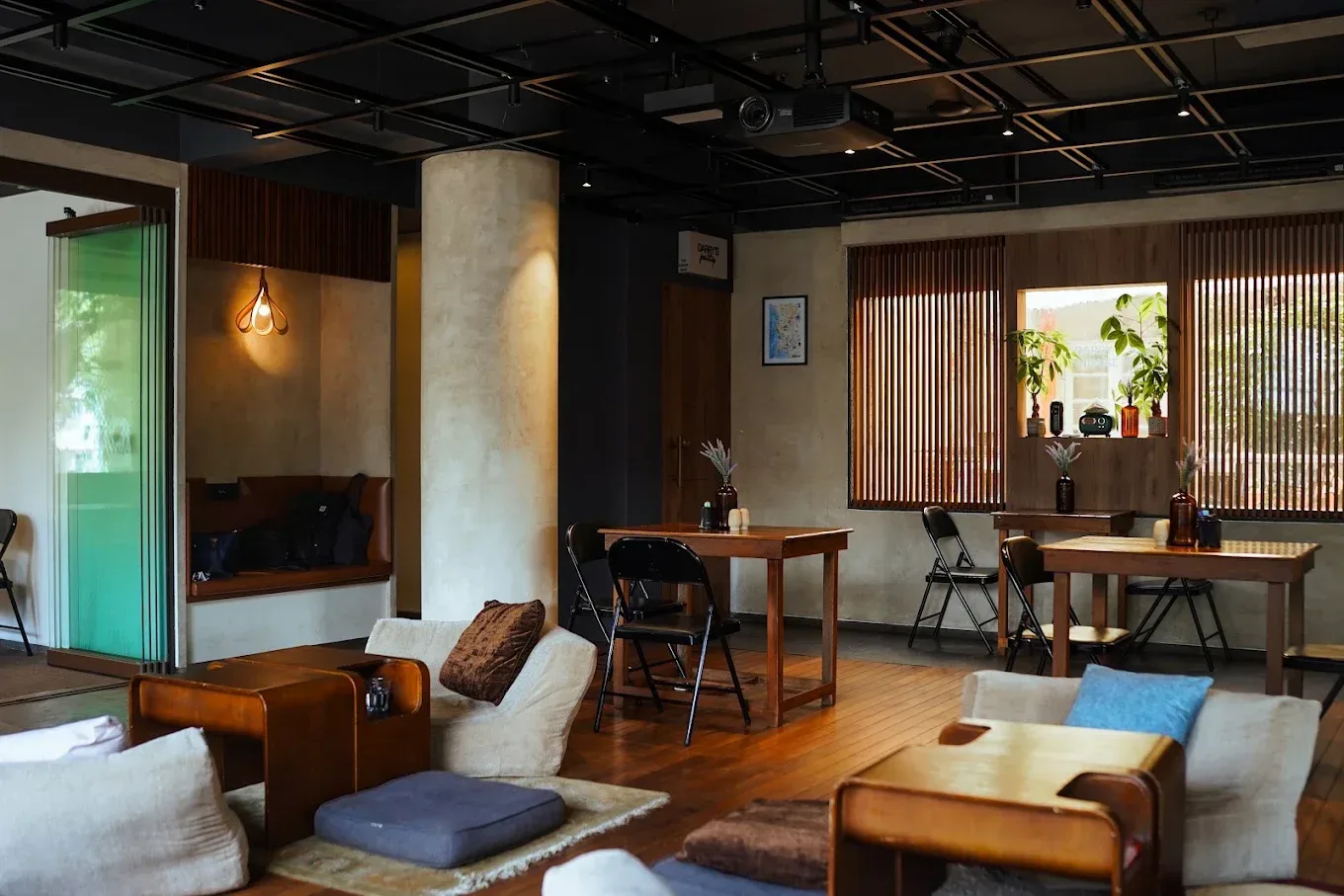
The guest list says 35 today. The programme is “a talk and drinks,” though someone has already suggested product demos. The terrace is the reason everyone likes the venue, but the date sits in a wet month. You can wait for every decision to settle, or test which room handles ordinary change with the least disruption.
That is the useful definition of flexibility here: likely changes stay quick, affordable and permitted. Movable chairs alone prove little. Attendance, weather and format are the scenarios that reveal whether the room can adapt without a new supplier, a lost programme block or a second booking.
Write down what is still moving
Before you compare venues, separate facts from assumptions. Headcount may land between 30 and 45. A presentation may become smaller demonstrations. Food, visual treatment, an outdoor welcome and vendor access may still move. Write down only the changes that are genuinely live in this brief.
This is not a sign that the organiser has failed. Early plans change. The mistake is pretending an assumption is fixed, then booking a room that works only if the assumption survives.
Mark each item as stable, likely to change or still unknown. The venue should be optimised for stable facts and tolerant of the rest.
Find the decisions that are expensive to reverse
Some choices can be changed with a 15-minute furniture reset. Others pull the whole plan behind them.
Fixed seating and fixed service
Built-in benches can create a strong social setting, but they limit how you divide the room. A fixed bar or service counter can simplify hospitality while making a different guest flow difficult. Neither is bad. They are expensive to reverse when the programme changes.
Ask which furniture is truly movable, who may move it and where it goes when removed. “Flexible layout” is incomplete if the spare furniture blocks a corridor or requires a vendor to collect it.
A single-purpose room
A room built around one focal point works well for a talk. It may struggle when the event needs four simultaneous product trials. A long dining room serves a seated meal cleanly but can make a standing mixer feel like a queue.
Look at the room without its current furniture arrangement. Can attention shift from front to centre? Can one activity become several without people crossing each other's work?
Narrow access windows
A venue may permit elaborate changes but allow only a short setup period. That makes flexibility theoretical. Confirm access, loading, vendor check-in and the latest time by which a layout decision must be final.
If a change needs more setup time than you can buy or book, score it as difficult even when the floor plan allows it.
Use the ALTR Reversibility Score
For each likely change, score the venue on four questions. Use 0, 1 or 2 points for each.
Permission
- 0: The host or building does not permit the change.
- 1: The change needs approval or a specific vendor.
- 2: The change is allowed within clear written rules.
Time
- 0: It cannot happen inside the booked access window.
- 1: It uses a meaningful part of setup or programme time.
- 2: It can happen inside the existing buffer.
Cost
- 0: It requires a second space, major supplier or sunk cost.
- 1: It adds labour, equipment or an extra booking hour.
- 2: It uses what is already included or planned.
Experience
- 0: The change leaves guests with poor sightlines, crowding or confusion.
- 1: The event still works, but with a visible compromise.
- 2: The guest experience remains coherent.
Add the four scores. A change scoring 7 or 8 is easy to absorb. A score of 4 to 6 needs a named backup and owner. A score below 4 is not a backup. It is a different event plan.
The numbers are a conversation tool, not a scientific rating. Their value is that they force cost, time and permission into the same decision.
Run three change scenarios before the recce ends
Do not ask a venue to be flexible in every imaginable direction. Test the three changes most likely to matter.
Attendance rises
Use the high end of the honest guest range, not the venue's maximum listing capacity. Place the registration point, food, bags, equipment and circulation in the drawing. If extra chairs fit only by removing the demonstration or accessible route, the venue has not absorbed the increase.
Then test the opposite. If attendance falls, can the room contract without feeling sparse? Screens, lighting zones and a tighter furniture cluster can help, but confirm what is available.
Rain arrives
Move the entire outdoor programme indoors on paper. Do not move only the guests. Include food, speakers, cables, displays and the route between them. The second-floor-plan method gives this scenario the detail it deserves.
The programme becomes interactive
Replace a single presentation with pairs, small groups or product stations. Can chairs turn without blocking aisles? Is there enough power where the activity moves? Can people hear instructions while several conversations happen?
The point is not to predict the final agenda. It is to learn which change makes the venue stop working.
Look for optionality you can actually use
Useful flexibility often comes from ordinary features: movable furniture with a storage place, connected zones, more than one focal wall, power where an activity may move, lighting that can separate tasks, a complete indoor fallback and enough setup time to make the change calmly. Written host rules turn those physical options into options you can actually use.
Every option carries a cost. Adjacent rooms can divide attention. Movable furniture still needs labour. An indoor backup may fit the people but not the atmosphere. Score the option after these consequences, not before them.
Compare two venues by change cost
Imagine Venue A looks exactly right for the current plan. Its furniture is fixed, the outdoor area holds the main programme, and additional equipment must come through an approved vendor. Venue B needs more styling today, but it has movable furniture, two usable zones and a written indoor fallback.
Venue A may still win if the brief is settled and weather exposure is acceptable. Venue B earns its advantage only when the unsettled assumptions are likely enough to justify it. Reversibility is not another word for better. It is insurance against specific changes.
For the final comparison, name the three likely changes and score each venue against permission, time, cost and experience. Circle every score that depends on an unconfirmed host answer. Price the weakest scenario, then choose the room whose compromises you understand and can afford.
Send a flexible-venue brief that hosts can answer
Try this structure:
We are planning for 30 to 45 people. The current format is a short presentation followed by small product trials. We need a whole-group indoor plan if rain affects the terrace, and we may need to create four activity zones. Please confirm what furniture can move, where it is stored, the available power points and the latest time we can lock the layout.
It is specific without pretending every choice is final. A host can respond with constraints, alternatives and the real cut-off for changes.
If confidentiality is one of the moving requirements, add the Four-Layer Privacy Check. Flexibility that exposes a closed meeting or unreleased product is not useful flexibility.
Browse ALTR venues with your three change scenarios beside you. For every shortlisted room, finish this sentence in writing: “If [likely change] happens, we will [specific response], and it will add [time, cost or compromise].” An answer you can live with is more useful than a promise of general flexibility.